The soda: the restaurant Costa Rica invented by accident
You are driving down any road in the country and you see the sign: SODA, hand-painted on a house with three tables. It is not a bar and it is not a drinks stand. It is where the entire country eats — and where you will eat better and cheaper than at any restaurant in the tourist strip.
Start with the thing that confuses everyone: a soda does not sell soda. It sells lunch. And the name, which looks like a translation error, is actually a linguistic fossil — the trace of a business that no longer exists.
Where the word comes from
In the 1940s and 50s the United States was living the golden age of the soda fountain: counters where fizzy drinks were mixed on the spot, carbonated water from a CO₂ cylinder combined with flavoured syrups. They were almost always inside pharmacies.
The fashion reached San José in the early fifties with the name half-translated: fuente de soda. And it arrived the same way it had up north — attached to pharmacies. As late as the mid-sixties two originals were still running: one in the Farmacia Iris, near the Mercado Central, and another in the Farmacia Leda, north of Hospital San Juan de Dios.
What happened next is the interesting part. In the late sixties and through the seventies, those counters began serving something to eat alongside the drink. First a sandwich. Then breakfast. Then a full lunch. And at some point the drink stopped being the business and the food took over — but the sign never changed.
So when you walk into a soda in Guanacaste or Limón and order a casado, you are using the name of a fizzy-drink machine that disappeared half a century ago. Nobody decided this. The name simply outlived the business.
The icebreaker
If you want to win over a Costa Rican, ask why they are called sodas. Most do not know. It is one of those things people use every day without ever wondering where it came from.
What a soda looks like inside
No two are the same, but nearly all share the same anatomy:
- A counter or a warm display case where you can see the day's food. There is no menu with photographs: you see what there is.
- A board on the wall with prices written by hand and corrected over the top when they rise. That is the real menu.
- Between three and eight tables, almost always with an oilcloth cover, almost always under a zinc roof.
- A blender that never stops. Fruit shakes are half the business.
- One woman cooking and serving, or two. It is a family business; the soda is usually named after her.
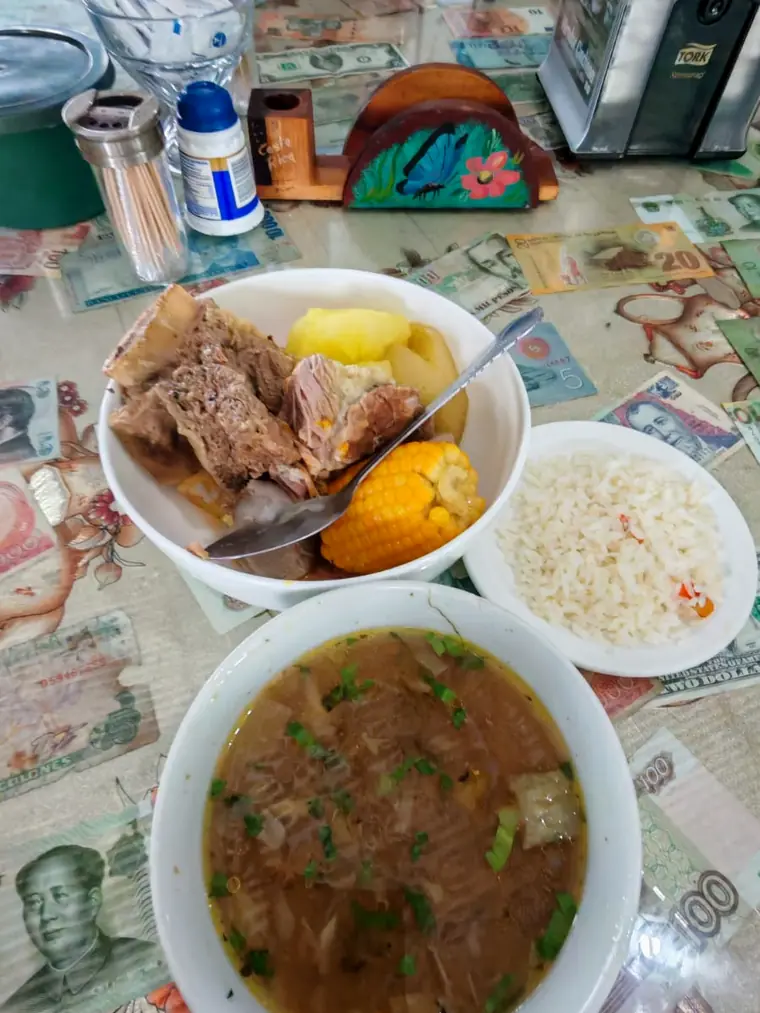
The unwritten rules
You order at the counter or from the table, depending on the place
If people are sitting and waiting, sit down. If everyone is standing in line, get in line. Watch for ten seconds before deciding and you will not get it wrong.
Shakes are ordered "en agua" or "en leche"
This is the question that throws every foreigner. A blackberry, cas, passion fruit or soursop shake is blended with either water or milk, and you have to say which. En agua comes out lighter and sharper; en leche comes out creamy, almost a dessert. If you say nothing they will ask you — and that question is the sign that you are being treated as a customer rather than a tourist.
The price on the board is usually the final price
In formal Costa Rican restaurants the bill adds 10% service and 13% VAT on top of the menu price, so the total arrives considerably higher than you calculated. In sodas, what the board says is normally what you pay. It is a difference in expectation worth knowing before you sit down in either.
Do not look for an English menu
Good sodas rarely have one, and that is precisely a good sign. Three words settle it: casado, con pollo or con carne, and un fresco de… whatever they have.
From the driver's seat
The fastest way to know whether a soda is good: look at the vehicles parked outside at midday. If there are delivery trucks, police cars or workers' vans, walk straight in. Those people eat there every day and they do not forgive.
The second sign is the clock. A soda that is full at 12:30 and out of casados by 1:45 is a soda that cooks the day's food and sells it. One that still has everything at three in the afternoon cooked too much.
The numbers, which is where the difference shows
A full casado at a roadside soda costs between ₡3,500 and ₡5,000 — roughly seven to ten dollars — and includes rice, beans, salad, fried ripe plantain, a protein and almost always a tortilla. An adult leaves full.
The same lunch, at a tourist-strip restaurant with an English menu and a photograph of every dish, will run you 18 to 25 dollars, plus 10% service and 13% VAT.
For a family of four eating out over ten days, that is several hundred dollars across the trip. And the soda food is, more often than not, better: it was cooked that morning, in small quantity, for people who will come back tomorrow.
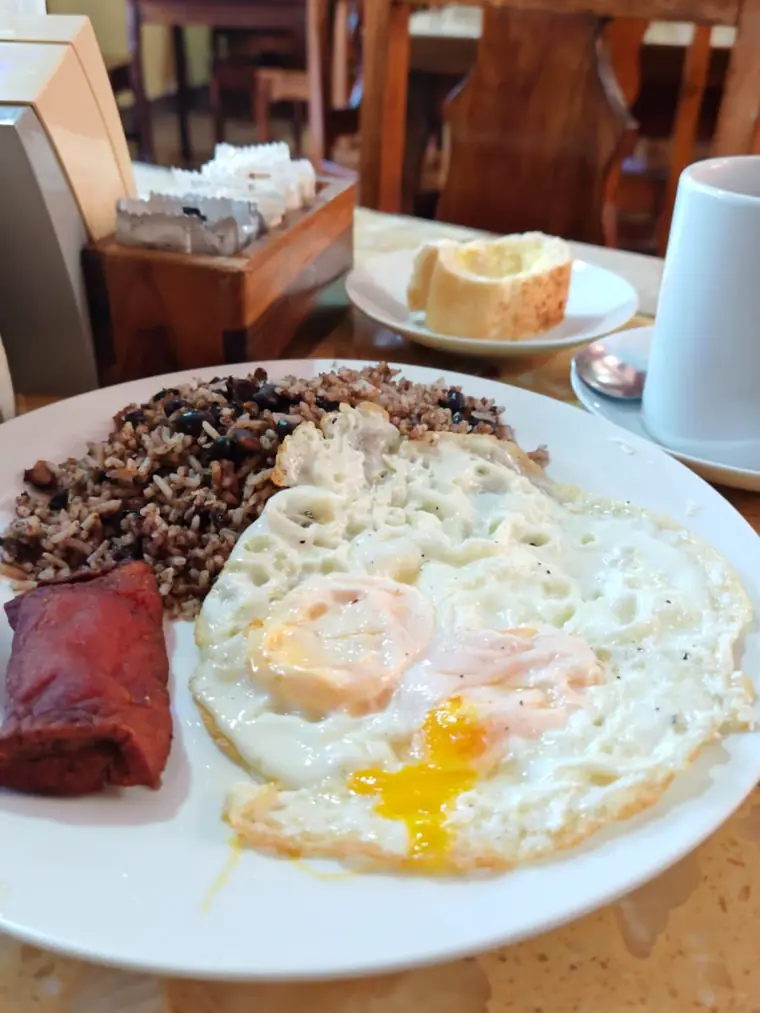
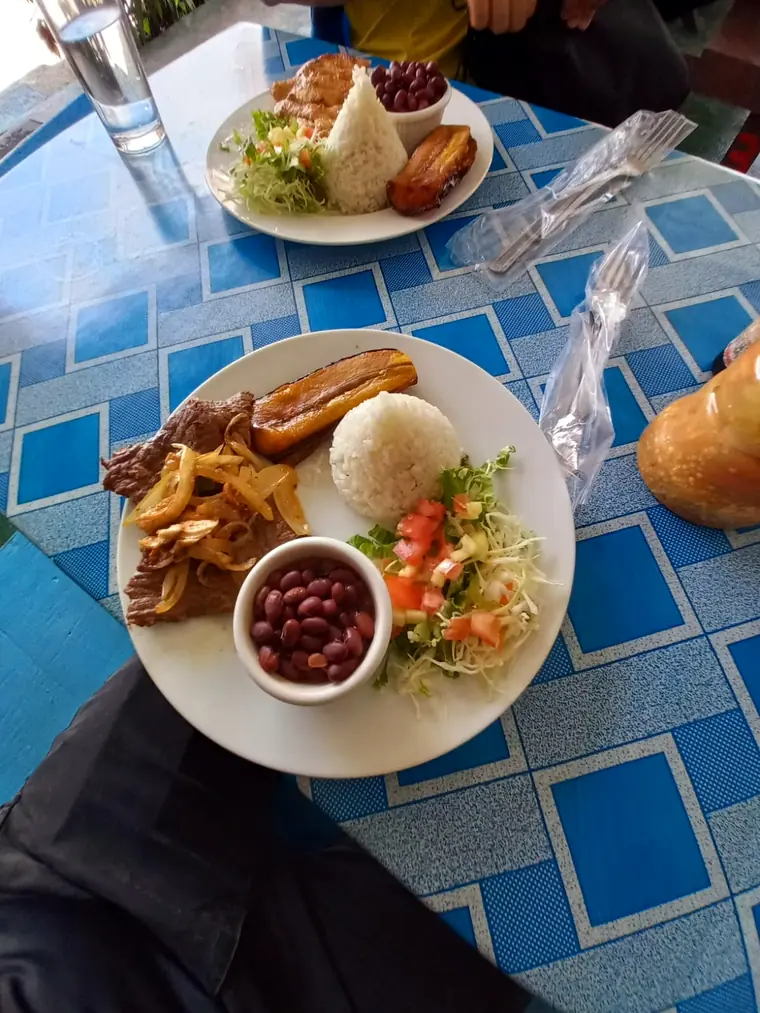
What to order if you have never been in one
- Casado con pollo, if it is your first time. It is the national dish in its most honest form and it lets you taste five things at once.
- Gallo pinto con huevo, in the morning. Served until about eleven, and it is the country's breakfast.
- Olla de carne, if it is Sunday and cool. Beef soup with cassava, taro, corn on the cob and plantain. You will not find it in a hotel.
- A fresco de cas, even if you do not know what it is. A sharp fruit that barely leaves Costa Rica and tastes like nothing you know.
- Chifrijo, if you want what young people eat. Beans, pork crackling, rice and pico de gallo in one bowl.
The short version
The soda is a 1950s fizzy-drink counter that turned into a restaurant and kept the old name. Today it is where the country eats: food of the day, final price on the board, seven to ten dollars for a full lunch. If there are trucks parked outside at midday, that is the one.
Sources
Want to stop at a real soda?
Our drivers stop where they eat themselves, not where they earn a commission. The lunch stop is added with Tropical Experts VIP: just tell us you want to eat well on the way.