La noche que la montaña resultó ser un volcán: la erupción del Arenal de 1968
Hay pueblos que crecen junto a un volcán sabiendo lo que es. La Fortuna no: aquí la gente vivió generaciones al pie de un cono perfecto convencida de que era un cerro más, hasta la mañana en que el cerro se abrió. Esta es la historia de la erupción de 1968 — la tragedia que décadas después se convirtió, sin que nadie lo planeara, en el motor turístico de toda una región.
A los pasajeros que suben con nosotros a La Fortuna les hacemos siempre la misma pregunta cuando el cono aparece por primera vez en el parabrisas: ¿sabía usted que hasta 1968 esto no era oficialmente un volcán? Casi nadie lo sabe. Y sin esa historia, La Fortuna no se entiende.
El cerro que daba buena tierra
Durante generaciones, el mapa decía «cerro Arenal» y la vida alrededor era de fincas: ganado, granos, familias sembrando en unas laderas de tierra negra y fértil — fértil, precisamente, por lo que había debajo. El volcán llevaba siglos dormido, tapado de bosque hasta la cumbre, y en la memoria de los vecinos jamás había hecho otra cosa que estar ahí, perfecto y quieto.
En los días finales de julio de 1968 la tierra empezó a temblar distinto: sismos repetidos, cada vez menos espaciados. No existía entonces la red de vigilancia vulcanológica que el país tiene hoy, y nadie leyó en esos temblores lo que anunciaban.
29 de julio de 1968
La mañana del lunes 29 de julio, el flanco oeste del cerro se abrió en explosión. No fue una erupción de postal, de lava bajando despacio: fue una explosión lateral que disparó bloques de piedra al rojo a kilómetros de distancia, con nubes ardientes de gas y ceniza corriendo ladera abajo más rápido de lo que nadie podía huir.
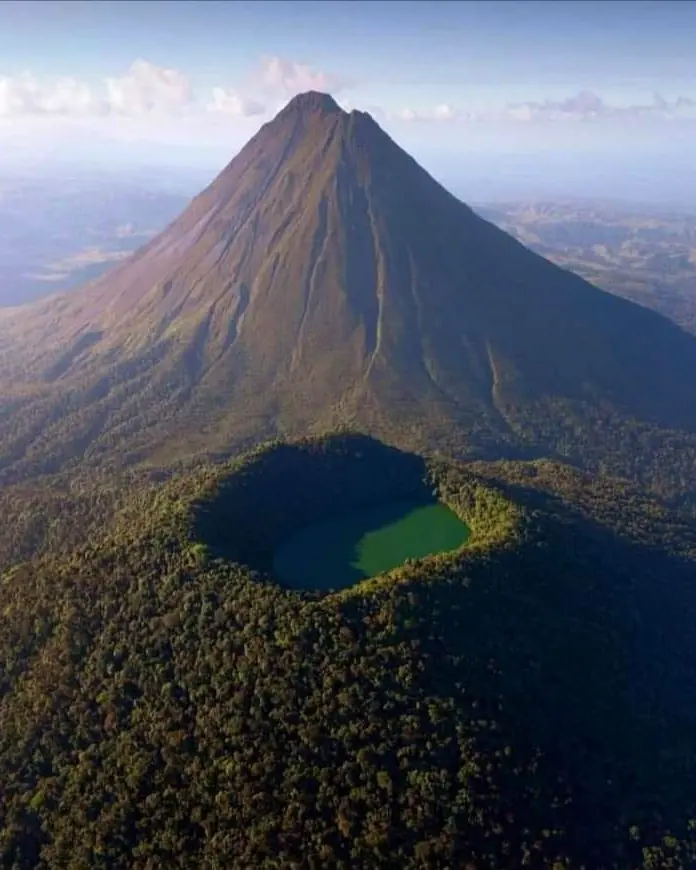
Del lado oeste — el lado que hoy mira al lago — quedaron sepultados los caseríos de Tabacón y Pueblo Nuevo. Murieron alrededor de 87 personas, la mayoría en los primeros minutos. La actividad continuó días, y la zona entera se evacuó. En la ladera quedaron tres cráteres nuevos, abiertos en línea, que los vulcanólogos bautizaron sin poesía: A, B y C.
Cuarenta y dos años encendido
Lo que empezó aquel julio no fue un episodio: fue una era. El Arenal se quedó activo durante 42 años seguidos, con coladas de lava, explosiones y ese resplandor naranja nocturno que le dio fama mundial. Durante décadas fue de los volcanes más activos del planeta, y verlo «trabajar» de noche era una de las experiencias clásicas de Costa Rica.
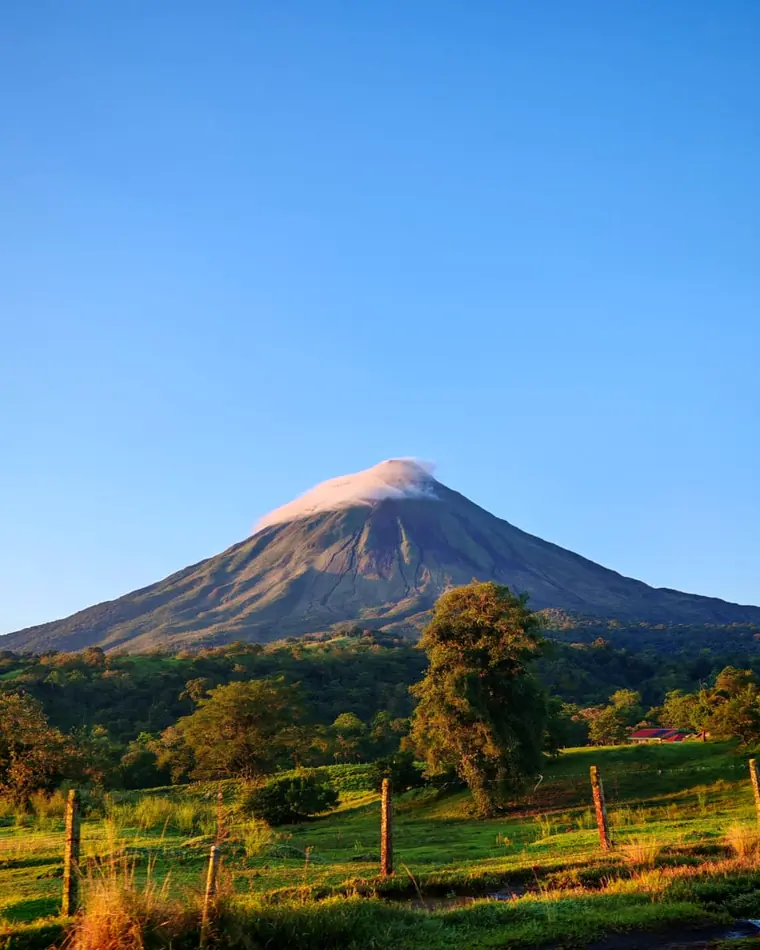
En octubre de 2010 la actividad se detuvo, y desde entonces el volcán está en fase de reposo. Se lo decimos con la honestidad de siempre, porque nos toca corregirlo varias veces por semana: hoy no se ve lava. Quien le venda la foto del río naranja le está vendiendo el Arenal de hace veinte años. Lo que sí hay es un cono perfecto de 1 670 metros, fumarolas, y una ventana casi diaria — de 6 a 9 de la mañana — para verlo entero.
La tragedia que fundó un destino
Aquí viene el giro que hace única esta historia. La erupción que destruyó la economía agrícola del lado oeste terminó creando, con los años, una economía nueva del lado este: la del pueblo que quedó en pie, La Fortuna — que hizo honor a su nombre, pues la explosión apuntó hacia el otro lado.
Primero llegaron los científicos, a estudiar uno de los volcanes más activos del mundo. Detrás los primeros viajeros, a ver la lava de noche. El agua que la montaña calienta bajo tierra se convirtió en las termales que hoy conoce todo el mundo — el río Tabacón corre tibio precisamente por donde bajó la muerte en el 68, y no se nos escapa la ironía. En 1991 la zona se protegió como Parque Nacional Volcán Arenal, y el pueblito ganadero se convirtió en el destino turístico más visitado del norte del país.
Lo que esta historia enseña al viajero
Tres cosas prácticas salen de todo esto. Primero: el volcán se ve mejor temprano — después de las 9 la nube casi siempre gana. Segundo: las termales no son una piscina calentada, son el volcán mismo — báñese en ellas sabiendo eso y la experiencia cambia. Y tercero: cuando camine los senderos de lava del parque nacional, está caminando literalmente sobre el 29 de julio de 1968 — las coladas petrificadas de aquella era siguen ahí, con el bosque abriéndose paso entre las piedras.
Del asiento del conductor
El mirador que preferimos para contar esta historia está del lado oeste, viendo el flanco de los cráteres nuevos con el lago abajo — ahí se entiende de un vistazo hacia dónde apuntó la explosión y por qué La Fortuna se salvó. Lo incluimos sin costo en cualquier traslado que pase por la zona: es una parada de diez minutos.
Y si le interesa la historia completa, pida el desvío al sector de las coladas del parque nacional como horas adicionales: caminar sobre la lava del 68 con el cono encima es de lo más impresionante que se puede hacer en Costa Rica sin fila ni tarima.
Lo esencial
29 de julio de 1968: el «cerro» Arenal explota por el flanco oeste, sepulta Tabacón y Pueblo Nuevo y deja unas 87 víctimas. Queda activo 42 años, hasta octubre de 2010; hoy descansa y no hay lava visible. De esa tragedia nació, sin plan, el destino turístico completo: las termales, el parque nacional de 1991 y el pueblo que le da nombre a nuestra base.
Fuentes consultadas
The night the mountain turned out to be a volcano: Arenal's 1968 eruption
Some towns grow up beside a volcano knowing what it is. Not La Fortuna: here, people lived for generations at the foot of a perfect cone convinced it was just another hill — until the morning the hill split open. This is the story of the 1968 eruption: the tragedy that decades later became, without anyone planning it, the engine of an entire region.
When the cone first appears in the windshield on the way up to La Fortuna, we always ask our passengers the same question: did you know that until 1968 this was not officially a volcano? Almost nobody does. And without that story, La Fortuna makes no sense.
The hill with the good soil
For generations the map said «Cerro Arenal», and life around it was farm life: cattle, grain, families planting slopes of black, fertile soil — fertile, precisely, because of what lay underneath. The volcano had slept for centuries, forested to the summit, and in living memory it had never done anything but stand there, perfect and still.
In the last days of July 1968 the ground began to tremble differently: repeated quakes, closer and closer together. The volcanic monitoring network the country has today did not exist, and nobody read in those tremors what they were announcing.
29 July 1968
On the morning of Monday 29 July, the hill's west flank burst open. This was not a postcard eruption with lava creeping downhill: it was a lateral explosion that hurled red-hot blocks kilometres away, with burning clouds of gas and ash racing down the slope faster than anyone could run.
On the west side — the side that today faces the lake — the villages of Tabacón and Pueblo Nuevo were buried. Around 87 people died, most in the first minutes. The activity went on for days and the whole area was evacuated. The blast left three new craters opened in a line on the flank, which the volcanologists named without poetry: A, B and C.
Forty-two years switched on
What began that July was not an episode: it was an era. Arenal stayed continuously active for 42 years, with lava flows, explosions and that orange night glow that made it world-famous. For decades it ranked among the most active volcanoes on the planet, and watching it «work» at night was one of Costa Rica's classic experiences.
In October 2010 the activity stopped, and the volcano has been in a resting phase since. We tell you this with our usual honesty, because we correct it several times a week: there is no visible lava today. Anyone selling you the photo of the orange river is selling you the Arenal of twenty years ago. What there is: a perfect 1,670-metre cone, fumaroles, and a near-daily window — 6 to 9 in the morning — to see it whole.
The tragedy that founded a destination
Here comes the turn that makes this story unique. The eruption that destroyed the farming economy of the west side ended up creating, over the years, a new economy on the east side: that of the town left standing, La Fortuna — which lived up to its name, «the fortunate one», because the blast pointed the other way.
First came the scientists, to study one of the world's most active volcanoes. Behind them, the first travellers, to watch the lava at night. The water the mountain heats underground became the hot springs everyone now knows — the Tabacón river runs warm precisely where death came down in '68, and the irony is not lost on us. In 1991 the area was protected as Arenal Volcano National Park, and the little cattle town became the most visited destination in the country's north.
What this story teaches the traveller
Three practical things fall out of all this. First: the volcano shows itself early — after 9 the cloud nearly always wins. Second: the hot springs are not a heated pool, they are the volcano itself — bathe in them knowing that and the experience changes. And third: when you walk the national park's lava trails, you are walking on 29 July 1968 itself — the petrified flows of that era are still there, with the forest pushing up between the stones.
From the driver's seat
Our favourite lookout for telling this story is on the west side, facing the flank with the new craters and the lake below — from there you grasp at a glance where the explosion pointed and why La Fortuna was spared. We include it at no cost on any transfer passing through the area: it is a ten-minute stop.
And if the full story interests you, ask for the lava-fields sector of the national park as extra hours: walking on the '68 flows with the cone above you is among the most impressive things you can do in Costa Rica with no queue and no stage.
The short version
29 July 1968: «Arenal Hill» explodes through its west flank, burying Tabacón and Pueblo Nuevo and leaving some 87 victims. It stays active for 42 years, until October 2010; today it rests, with no visible lava. From that tragedy grew, unplanned, the whole destination: the hot springs, the 1991 national park, and the town our company calls home.
¿Quiere conocer el Arenal con alguien de aquí?
Want to meet Arenal with someone from here?
Vivimos a sus pies. Lo llevamos a los miradores correctos, a la hora en que el cono se despeja, y le contamos esta historia donde ocurrió. Precio final por vehículo.
We live at its feet. We take you to the right lookouts, at the hour the cone clears, and tell you this story where it happened. Final price per vehicle.